

Blogs
What Is a COB LED Display? Technology, Features and Benefits Explained

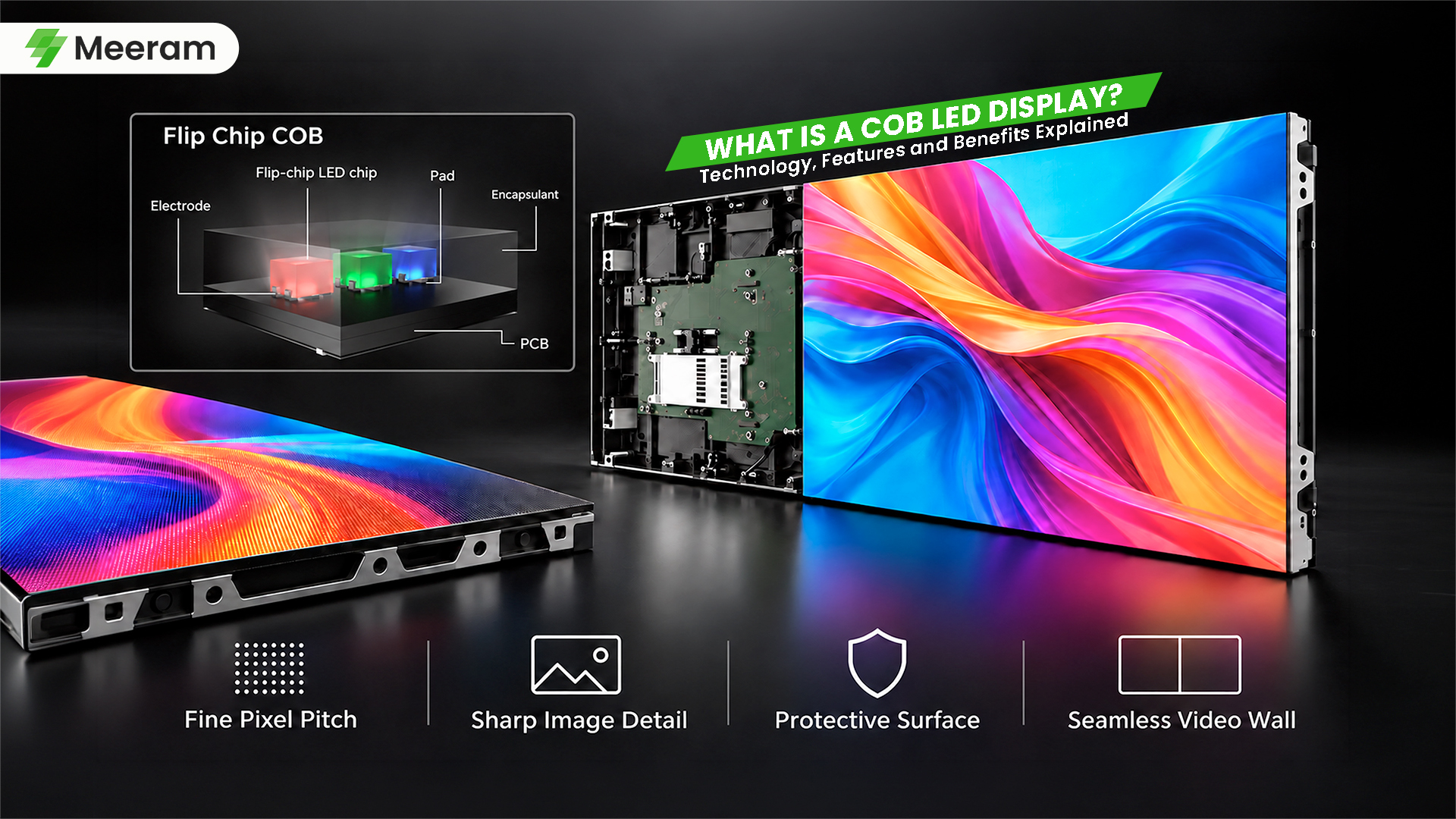
Digital displays have become an important part of modern offices, conference rooms, retail stores, and commercial spaces. Businesses increasingly need screens that can show detailed information, clear images, and high-quality videos without compromising visibility. While traditional LED screens continue to serve many purposes, newer display technologies have introduced improvements in screen construction, pixel density, and durability. One of these technologies is the COB LED display.
COB LED displays are particularly useful in environments where people view large screens from relatively short distances. Their compact LED arrangement allows manufacturers to produce fine-pitch screens capable of displaying detailed content. However, before choosing this technology, it is important to understand how it works, what makes it different from conventional LED displays, and whether its benefits justify the investment.
What Is a COB LED Display?
COB stands for Chip on Board, a technology in which tiny LED chips are mounted directly onto a printed circuit board (PCB). Instead of using individually packaged LED lamps, the chips are arranged close together and covered with a protective encapsulation material. This construction creates a relatively smooth display surface while providing protection for the delicate electronic components underneath.
Like other direct-view LED displays, COB screens use red, green, and blue light to produce images. The display system controls the brightness of these colours to create photographs, videos, text, and other digital content. What makes COB technology different is primarily the way its LED chips are packaged and protected, rather than the basic principle of producing an image.
COB technology is particularly suitable for fine-pitch LED displays, where large numbers of pixels must fit into a limited physical area. This makes it an attractive option for meeting rooms, control centres, executive offices, and other indoor environments where image detail matters.
How Does COB LED Display Technology Work?
A COB LED display contains thousands or millions of small LED chips arranged across multiple display modules. These chips produce the light that forms the final image. Although the manufacturing process requires specialised equipment, the basic operation can be understood through four important stages.
LED Chip Mounting
The process begins by placing LED chips directly onto a specially designed circuit board. These chips are positioned according to the required pixel pitch, which determines how closely the pixels are arranged. A smaller distance between pixels allows more image detail to fit into the same screen area, making fine-pitch COB displays useful for close viewing.
Electrical Connections
After mounting, the LED chips are connected to the circuit board so they can receive electrical signals. Different manufacturers use different connection methods, including wire bonding and flip-chip technology. These connections allow the display electronics to control the light produced by individual pixels and reproduce the required image.
Protective Encapsulation
Once the chips are mounted and connected, a protective material is applied over the LED array. This layer helps protect the components against accidental contact, dust, and certain environmental conditions. It also creates a more continuous surface compared with conventional LED modules that contain individually packaged lamps.
Image Formation
During operation, a controller processes the incoming video signal and sends the necessary information to the display modules. Driver electronics regulate the light output of the red, green, and blue elements, allowing each pixel to produce different colours and brightness levels. The combined output of these pixels creates the complete image visible to viewers.
Key Features of COB LED Displays
COB LED technology offers several characteristics that make it suitable for professional indoor display installations. These features are particularly valuable when businesses need detailed images, dependable screen performance, and a display that can withstand regular use.
Fine Pixel Pitch and High Resolution
Pixel pitch refers to the distance between the centres of neighbouring pixels, measured in millimetres. COB technology supports very small pixel pitches, allowing manufacturers to fit a greater number of pixels into a relatively small display area. Common fine-pitch options include P0.9, P1.2, and P1.5, where the number represents the approximate distance between pixels.
For example, a P0.9 COB display has more pixels within the same physical dimensions than a P1.5 display. This can produce sharper text and more detailed images when the screen is viewed closely. However, a smaller pixel pitch is not always necessary, as the ideal choice depends on viewing distance, screen dimensions, content requirements, and budget.
Protective Display Surface
One of the most noticeable differences between COB and conventional SMD LED displays is the construction of the display surface. COB technology places a protective encapsulation layer over the LED chips, reducing their direct exposure to physical contact. This can make the display more resistant to minor accidental touches and handling-related damage. This protection is particularly useful in commercial spaces where screens may be installed near staff, visitors, or customers. However, COB displays are not completely resistant to physical damage, and their actual durability depends on the materials and manufacturing standards used.
Improved Image Detail
The high pixel density available with fine-pitch COB technology makes it possible to display detailed information across large screens. Text, diagrams, charts, and graphics can remain clear when viewers are relatively close to the display, provided the screen has sufficient resolution for the intended content. This capability is valuable in meeting rooms and monitoring environments where users need to examine information rather than simply watch videos. For businesses working with detailed presentations or dashboards, appropriate pixel density can make a meaningful difference to everyday usability.
Contrast and Surface Consistency
Many COB displays use dark surface treatments designed to improve perceived contrast and reduce unwanted reflections. When combined with suitable display electronics and calibration, these treatments can help produce deeper-looking black areas and consistent image presentation. This can be beneficial in corporate meeting rooms, studios, and premium commercial environments. However, contrast performance depends on the complete display design, and COB packaging alone does not guarantee superior image quality.
Heat Management
LED screens generate heat during operation, particularly when displaying bright content for extended periods. Certain COB constructions provide an efficient thermal path between the LED chips and circuit board, helping heat move away from sensitive components. Effective heat management supports stable operation, but it also depends on cabinet construction, power consumption, ventilation, and installation conditions. Businesses planning to operate screens for long hours should review the manufacturer’s recommended operating requirements.
Benefits of COB LED Displays for Businesses
The advantages of COB LED displays become easier to understand when considering how they are used in real working environments. Rather than focusing only on technical specifications, businesses should consider how the technology can improve visibility, usability, and screen protection.
Clear Images at Short Viewing Distances
In conference rooms and offices, viewers often sit only a few metres away from a large display. Conventional LED screens with wider pixel spacing may reveal individual pixels when viewed from this distance. Fine-pitch COB displays address this requirement by placing pixels closer together, allowing images and text to appear more detailed. For organisations that regularly display financial reports, presentations, spreadsheets, or technical information, this can improve the viewing experience. The benefit is especially noticeable when the screen dimensions and pixel pitch are selected according to the room layout.
Better Protection During Everyday Use
Commercial displays are sometimes installed in environments where accidental contact is difficult to avoid. The encapsulated surface of COB displays helps protect the underlying LED chips, potentially reducing certain types of contact-related damage compared with exposed LED packages. This feature can be valuable in busy offices, showrooms, and shared spaces. Nevertheless, appropriate installation, cleaning practices, and handling remain essential to maintaining the display.
Large Displays Without LCD Panel Bezels
COB LED modules can be assembled into large video walls, allowing businesses to create display surfaces in different dimensions. Unlike traditional LCD video walls, direct-view LED installations do not have the visible panel bezels typically found between LCD screens. This makes the technology attractive for corporate presentations, digital signage, and environments where uninterrupted visual content is important. The final appearance still depends on cabinet alignment, installation quality, and display calibration.
Suitable for Extended Operation
Some commercial environments require screens to operate throughout the working day or for much longer periods. Control rooms, security monitoring centres, and information displays are examples where extended operation may be necessary. COB LED displays can be suitable for these applications when the selected model is designed for the required duty cycle. Buyers should verify operating-hour ratings, thermal requirements, warranty conditions, and available maintenance support before making a purchase.
COB LED vs SMD LED Display: What’s the Difference?
COB and SMD are two different LED packaging technologies. SMD stands for Surface-Mounted Device and generally uses individually packaged LED components mounted onto a circuit board. COB, on the other hand, mounts the LED chips directly onto the substrate before applying a protective encapsulation layer.
Both technologies are widely used in commercial LED displays, but their practical advantages differ depending on the application.
| Feature | COB LED Display | SMD LED Display |
|---|---|---|
| LED construction | Chips mounted directly on a circuit board | Individually packaged LED components |
| Display surface | Encapsulated LED array | Generally exposed LED packages |
| Pixel pitch | Particularly suitable for fine-pitch displays | Available across many pixel pitches |
| Physical protection | Often improved protection against contact | Depends on package and screen design |
| Maintenance | May require specialised repair or module replacement | Individual LED replacement is often easier |
| Initial cost | Often higher for comparable installations | Frequently more economical |
| Common applications | Premium indoor displays and control rooms | Indoor and outdoor display installations |
For example, a large outdoor advertising screen viewed from a considerable distance may not require the fine pixel density offered by COB technology. In this situation, a conventional SMD display may provide better value. However, for a corporate conference room where participants sit close to the screen, a fine-pitch COB display may be worth considering.
Neither technology is automatically the best solution for every project. Viewing distance, installation conditions, resolution requirements, and overall cost should guide the final decision.
Common Applications of COB LED Displays
COB LED displays can be used in several professional environments, particularly where large screen dimensions and detailed image presentation are important.
Corporate Meeting Rooms
Businesses use meeting room displays for presentations, video conferences, project discussions, and financial reporting. Fine-pitch COB technology can make detailed content easier to view from different seating positions. It can also provide a large display surface without the panel borders associated with LCD video walls.
Control and Monitoring Centres
Control rooms often display multiple information sources simultaneously, including dashboards, system alerts, maps, and camera feeds. These applications require sufficient resolution to keep information readable across the screen. COB displays can be considered where high pixel density and large display dimensions are required.
Retail Stores and Showrooms
Premium retail stores use digital displays to showcase products, promotional videos, and brand messages. COB LED video walls can create large visual installations while providing a protected screen surface. The right pixel pitch and brightness should be chosen according to customer viewing distance and ambient lighting.
Broadcast Studios
Broadcast studios may use LED displays for backgrounds, information presentation, and visual production. COB technology can support fine-pitch installations, although additional specifications such as refresh rate, colour accuracy, camera compatibility, and flicker behaviour must be evaluated carefully.
Limitations of COB LED Display Technology
Although COB displays offer several advantages, they also have limitations that buyers should understand. One of the most important considerations is the initial investment. Fine-pitch COB displays can cost more than conventional SMD alternatives, particularly when a project requires a large screen with high pixel density. Maintenance is another factor worth examining. Because the LED chips are protected beneath an encapsulation layer, individual chip repairs may require specialised equipment and trained technicians. Depending on the manufacturer’s service approach, replacing an entire display module may be more practical than repairing a single pixel.
It is also important to remember that COB technology does not guarantee identical performance across all products. Display quality depends on chip selection, driver electronics, manufacturing precision, calibration, cooling, and other components. Buyers should compare complete specifications and service arrangements rather than relying on the technology name alone.
How to Choose the Right COB LED Display in Pakistan
Choosing a COB LED display should begin with a clear understanding of where the screen will be installed and how it will be used. The available wall dimensions, viewing distance, content type, and intended operating hours all influence the most suitable configuration. For example, a business planning to display detailed spreadsheets in a small conference room may benefit from a finer pixel pitch than a showroom displaying promotional videos to customers standing farther away. Selecting a smaller pixel pitch than necessary can increase project costs without delivering a meaningful improvement for the intended audience.
Buyers should also evaluate screen resolution, brightness, contrast, refresh rate, power requirements, maintenance access, and warranty coverage. In Pakistan, imported equipment availability, installation arrangements, spare modules, and local technical support can affect the overall ownership experience.
At Meeram Store, you can explore COB LED display options, including P0.9, P1.2, and P1.5, for different indoor applications. Comparing these options according to viewing requirements and project specifications can help businesses make more informed purchasing decisions. We are your one stop store for Digital Displays in Pakistan.